

 CANADA
 INDONESIA
 NEW ZEALAND
 SAUDI ARABIA
 SINGAPORE
 SOUTH AFRICA
 UNITED ARAB EMIRATES
 UNITED KINGDOM
 UNITED STATES
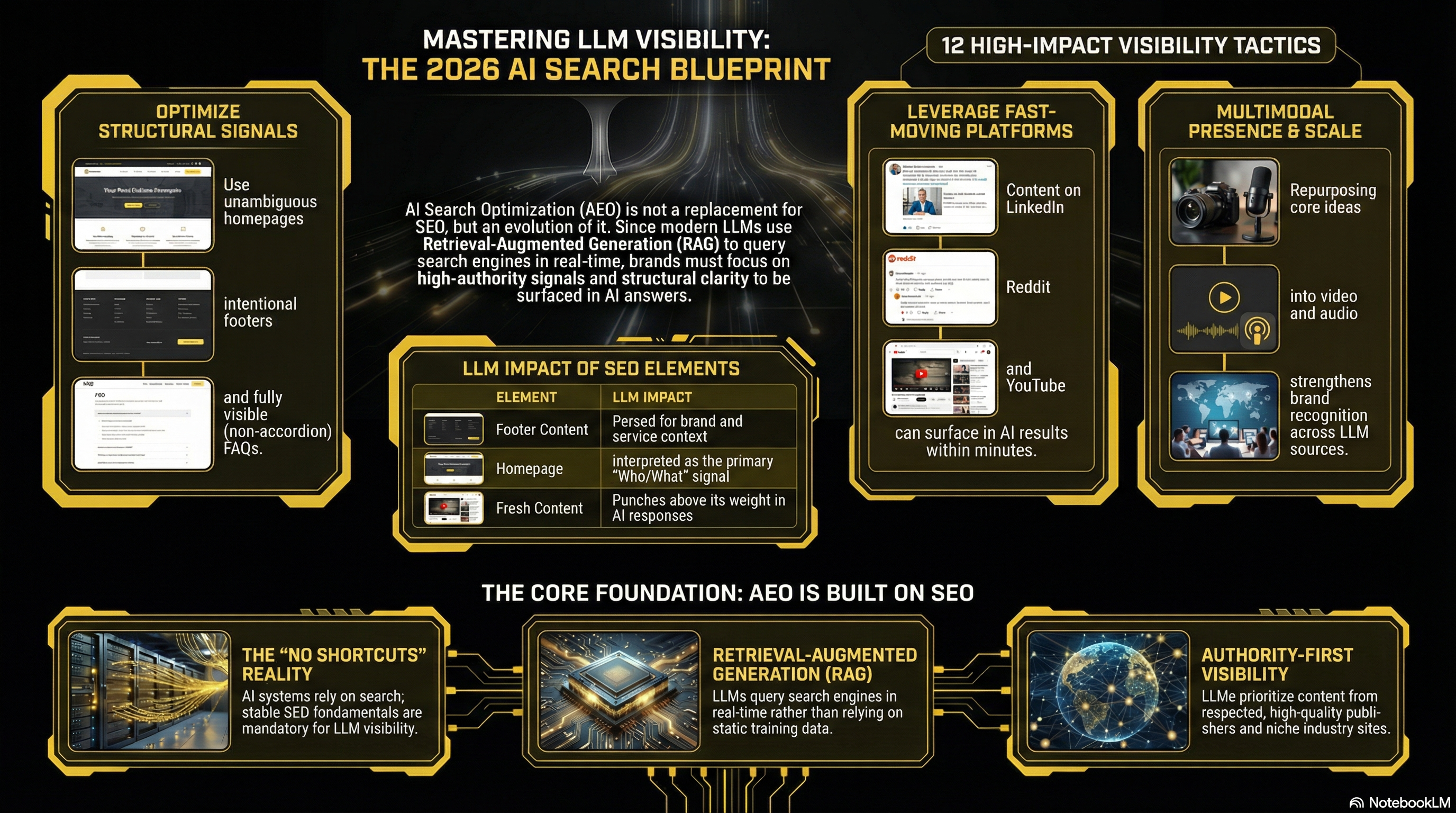
Is AEO different from SEO?
What actually works in AI search heading into 2026
A panel of some of the most trusted voices in SEO recently unpacked how large language models surface brands, why shortcuts rarely last, and which tactics are delivering real results today.
One of the biggest challenges facing SEO right now isn’t artificial intelligence itself—it’s the volume of misleading and overconfident advice surrounding it.
SEO isn’t disappearing. It’s changing. That shift makes it even more important to understand how search is evolving and to be selective about whose guidance you trust.
I don’t shock easily, but some of the AEO (or GEO) presentations over the past year have been genuinely hard to sit through. More than once, I’ve heard speakers declare SEO “dead,” only to follow up with recycled tactics dressed up as breakthroughs for LLM visibility. It’s been rough.
Fortunately, a much-needed reality check arrived this week. Lily Ray, Kevin Indig, Steve Toth, and Ross Hudgens—four people with deep, proven experience—came together for a roundtable on the future of search. It was easily the most grounded and useful discussion on AI search I’ve seen, filled with tactics they’re actively using to gain visibility in LLM-driven results.
Here are the key takeaways.
1. Advertorials can influence AI visibility
LLMs don’t currently differentiate between paid editorial and earned coverage. As a result, advertorials on credible, high-quality publishers can contribute to AI search visibility in much the same way as traditional PR. As always, the authority of the publication matters far more than the placement itself.
2. Syndication helps—but only when done carefully
Content syndication can expand reach quickly, but volume alone won’t help. Prioritize relevance and publisher quality, and avoid indiscriminate distribution that dilutes brand signals.
3. Build pages for every audience and use case
Brands with clearly defined pages for different industries, audiences, and problems are better positioned as AI search becomes more personalized. This structure improves LLM comprehension and remains a best practice regardless of how search evolves.
4. Make your homepage unambiguous
Your homepage should clearly state who you serve and what you offer. LLMs interpret homepage content far more effectively than navigation menus, so relying on your nav to explain your business is a missed opportunity.
Footers are increasingly being parsed for brand and service context. Wil Reynolds shared compelling evidence that footer content can directly affect AI visibility when used intentionally.
6. Ignore the hype around llm.txt
Despite widespread speculation, no major LLM has confirmed using llm.txt files—and Google has explicitly said it does not. This isn’t where teams should be investing their time right now.
7. Publish across formats
Repurposing core ideas into text, video, audio, and visuals strengthens brand recognition across the many sources LLMs draw from. Multimodal presence matters more than ever.
8. Take control of your brand narrative
Shaping how an LLM understands your brand requires scale and consistency. It’s estimated that hundreds of documents may be needed to materially influence perception. Brands that don’t publish regularly risk letting others define them.
9. Fresh content punches above its weight
Recent content often performs disproportionately well in AI search, reflecting LLM preferences for up-to-date information. That said, superficial updates without substance can do more harm than good.
10. Social platforms move fast
Content on LinkedIn (including Pulse articles) can surface in AI results within hours—or even minutes—especially for established accounts. Reddit, YouTube, and other trusted platforms show similar speed.
11. Authority speeds up inclusion
Publishing on respected, niche industry sites can lead to rapid visibility in LLM responses, sometimes almost immediately.
12. Don’t bury your FAQs
FAQs should be visible, detailed, and easy to access—not hidden behind accordions. Eight to ten well-written answers can strongly signal expertise, relevance, and intent to both users and AI systems.
So—is AEO the same as SEO?
This question came up directly at Google Search Live in December, where John Mueller addressed it head-on. His message left little room for interpretation:
“AI systems rely on search. There is no such thing as GEO or AEO without SEO fundamentals. Short-term tricks will come and go, but companies that want long-term success should focus on proven, stable practices—not gimmicks.”
That stance aligns with how modern LLMs like GPT-5 actually function. They use Retrieval-Augmented Generation (RAG), which allows them to query search engines and trusted sources in real time rather than relying solely on static training data.
In plain terms: if your brand isn’t visible in search, it’s unlikely to be visible in AI-generated answers either.
Yes—strong AEO is built on strong SEO. The tactics above are effective today, but they’ll continue to evolve as LLMs and search systems mature.
The smartest AI search strategy for 2026
There’s no magic switch. Keep experimenting. Question bold claims. And be deliberate about who you listen to—especially in an environment where hype travels faster than evidence.

Michael Doyle
Michael is a digital marketing powerhouse and the brain behind Top4 Marketing and top4.online. His know-how and over 23 years of experience make him a go-to resource for anyone looking to crush it in the digital space. To get the inside scoop on the latest and greatest in digital marketing, be sure to read his blog posts and follow him on LinkedIn.