


 CANADA
 INDONESIA
 NEW ZEALAND
 SAUDI ARABIA
 SINGAPORE
 SOUTH AFRICA
 UNITED ARAB EMIRATES
 UNITED KINGDOM
 UNITED STATES
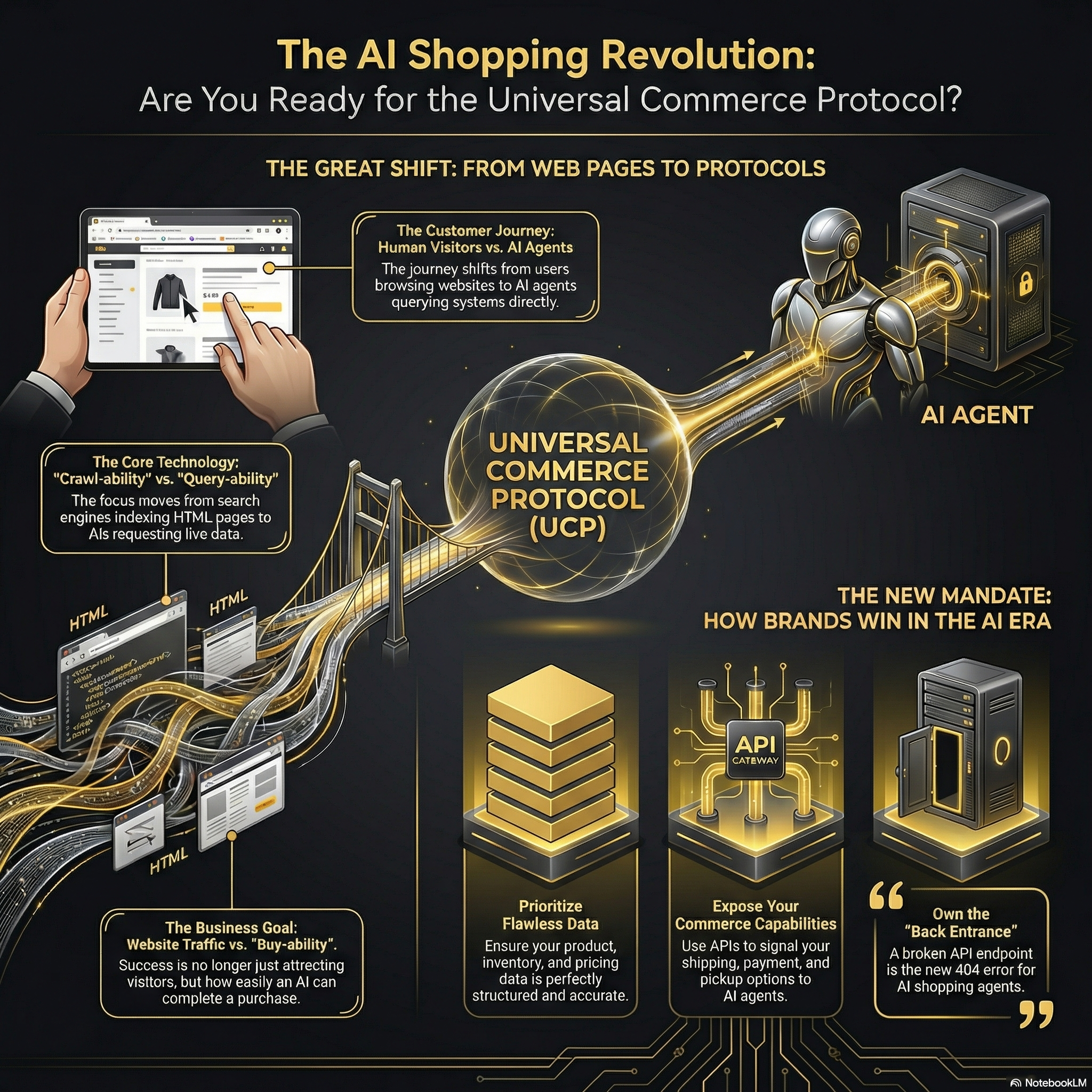
The digital commerce landscape is on the cusp of its most profound transformation since the advent of mobile. While most businesses are still grappling with traditional SEO and customer journeys, a quiet but seismic shift occurred in January 2026 with the official launch of the Universal Commerce Protocol (UCP). Co-developed by Google and Shopify, and backed by over 20 industry giants including Walmart, Target, Visa, and Stripe, UCP is poised to redefine how consumers discover and purchase products.
If your SEO strategy is solely focused on page rankings, you might be missing the biggest opportunity—or threat—of the decade.
The End of the Website-Centric Purchase Journey
For decades, the internet has operated on a simple premise: if a customer wants to buy something, they navigate to a website. Search engines like Google have been the primary gatekeepers, directing users to the right landing page.
UCP changes this fundamentally. It’s an open-source standard designed to enable agentic commerce, allowing AI agents (like Google AI Mode in Search and Gemini) to interact directly with retailers’ backend systems. Imagine this:
“Find me the best noise-canceling headphones under $300 with fast shipping.”
Today, an AI might open multiple tabs, scrape information, and present a summary. With UCP, the AI won’t need to open any tabs. Instead, it can directly query brands via the protocol:
- “Who has this in stock, right now?”
- “What’s the exact price, including any eligible discounts?”
- “What are the available variants (color, size)?”
- “Can I buy it instantly, and what are the shipping options to the user’s location?”
The AI receives structured data back, processes it, and can even complete the checkout—all without the user ever leaving the AI interface. This isn’t just a new way to find information; it’s a new way to transact.
From Pages to Protocols: The New Discovery Layer
UCP is not an evolution of web crawling; it’s a parallel discovery layer built for machines. It provides a standardized way for AI agents to:
- Discover Products: Not by crawling HTML, but by querying structured product data feeds.
- Check Inventory & Prices: In real-time, directly from the merchant’s system.
- Understand Variants, Shipping & Availability: Accessing precise, executable commerce data.
- Complete Checkout: Utilizing modular payments and tokenized credentials for a seamless transaction.
This means product discovery is shifting from optimizing individual web pages to optimizing your commerce data protocols. Where Schema.org provided semantic understanding for search engines, UCP provides transactional understanding for AI shopping agents.
What This Changes for Brands: The Battle for “Buy-Ability”
In this agentic future, brands will increasingly compete on:
- Data Quality & Structure: How precisely their product information (GTINs, variants, availability) is structured and maintained.
- Protocol Exposure: How clearly their inventory, pricing, and transactional capabilities (e.g., “Supports in-store pickup,” “Offers next-day delivery,” “Accepts Google Pay”) are exposed via UCP manifests and APIs.
- Transactional Readiness: How easy and reliable it is for an AI agent to complete a purchase through their systems.
The brands whose systems provide clean, confident, and executable answers to an AI’s queries will win the sale. Not because they had the best landing page that day, but because they had the most machine-readable, AI-ready commerce layer.
The New Frontier for Enterprise SEO: Owning the “Back Entrance”
This is where the role of Enterprise SEO transforms from a tactical pursuit of rankings into a strategic mandate with direct revenue impact. Forward-thinking SEO teams must begin to own:
- Product & Inventory Data Quality: Collaborate with product and data engineering teams to ensure core commerce data is impeccable, real-time, and adheres to structured standards. This goes beyond basic product feeds; it requires deep accuracy in stock levels, variant management, and pricing.
- Structured Commerce Feeds & APIs: Work closely with engineering to implement UCP-style APIs and manifests. This involves auditing existing product schema, ensuring robust GTINs, and validating how “buy-ability” is explicitly exposed to AI systems. Remember, a broken API endpoint is the new 404 error for AI agents.
- “Query-Ability” vs. “Crawl-Ability”: Your brand doesn’t just need to be crawlable by search engines; it needs to be queryable and transactable by AI agents. This means understanding the capabilities your UCP manifest advertises and ensuring your backend systems can deliver on them consistently.
Just as log files revolutionized SEO by showing how search engines interacted with your site, “agent logs” will become the next critical tool, revealing why AI agents succeed or fail in completing transactions on your behalf.
Why Early Adopters Will Dominate
In a world where AI agents become trusted personal shoppers, the brands that offer clean, robust commerce protocols will become the default suppliers. Everyone else risks becoming invisible in the AI-driven purchasing funnel.
Companies like Shopify have already integrated UCP natively, making millions of its merchants “AI-ready” out of the gate. Major players like Walmart, Target, Wayfair, and Etsy were among the initial adopters in January 2026, rolling out UCP-powered experiences with Google AI Mode and Gemini. The ecosystem is building rapidly.
This is more than just another algorithm update. UCP represents a fundamental shift in how commerce operates. Websites aren’t disappearing, but they are no longer the only door to your products. UCP just gave AI a direct “back entrance,” and the brands that master this new pathway will define the future of shopping

Michael Doyle
Michael is a digital marketing powerhouse and the brain behind Top4 Marketing and top4.online. His know-how and over 23 years of experience make him a go-to resource for anyone looking to crush it in the digital space. To get the inside scoop on the latest and greatest in digital marketing, be sure to read his blog posts and follow him on LinkedIn.